
Africa Archives
Dr Rice to visit Libya in October
Filed under: Africa
For the first time since 1953, the US Secretary of State Condoleezza Rice will visit Libya. Dr Rice is to visit the country in October. The last US Secretary of State to visit Libya was John Foster Dulles.
US State Department sources explained that the visit, which had been planned for an earlier date, had been postponed for reasons connected to the progress of political reform in Libya.
 del.icio.us |
  digg |
  technorati |
  stumble upon |
  furl |
  reddit
Jihad on Horseback
Filed under: Africa
"Two years ago, Al Arabiya producer Nabil Kassem was asked to put together a documentary film on Darfur. What he witnessed there, and recorded in this film, were scenes of unspeakable brutality and untold suffering, scenes he thought would surely wake up an Arab public all too willing to let Darfur pass by. But Jihad on Horseback never made it across the airwaves. Watch the film to see perhaps the most provocative Arab documentary ever made." ( Atlas Shrugs)
You can see the video here.
del.icio.us | digg | technorati | stumble upon | furl | redditA Moment of Opportunity: China, Darfur, and the 2008 Olympics
Filed under: Africa ~ Asia
China, on a domestic and international cleaning binge, is seeking to cleanse its status and reputation by the time it begins hosting the Olympics in 2008 to appear as a developed nation in a first-world prom dress. While this may appear as a farcical whitewash operation by a totalitarian regime, it presents an opportunity for the international community to take concrete steps in resolving the Darfur crisis.
del.icio.us | digg | technorati | stumble upon | furl | redditSay Goodbye to Bread, Hello to Air Pie!
Filed under: Africa ~ Zimbabwe
Good 'ole Mugabe, liberator of the people of Zimbabwe, has decided that enough is enough. The Western imperialists seeking to overthrow him have apparently become too powerful for his liking. As the country completely deteriorates, and the opposition begins to gain momentum, what does he do? Ban all aid organizations, of course! It only makes sense.ZIMBABWE has cancelled the licences of all aid groups, accusing them of working with the opposition to oust President Robert Mugabe, sparking fears the ban could cut food supplies to hundreds of thousands of people in the nation dependent on handouts. Information Minister Sikhanyiso Ndlovu said that all non-governmental organisations had been deregistered and would have to reapply for permits, reports said yesterday.This is basically committing the entire country to suicide. This year's harvest brought in absolutely nothing. The only reason people have been surviving at all is because of Western aid programs that distribute food to people. That this happened though is not that all surprising. As opposition to Mugabe's rule mounts, so does his will to crack down on dissent. He has used food as a political weapon since the day he gained power, especially noticeable in the 2005 election when food was distributed all over the place in order to buy votes.Dr Ndlovu said the authorities wanted to identify groups working with "agents of imperialism" to overthrow Mr Mugabe, who is facing growing resistance from Zimbabweans impoverished by his 27-year stranglehold on power, The Times reported.
"Pro-opposition and Western organisations masquerading as relief agencies continue to mushroom, and the Government has annulled the registration of all NGOs in order to screen out agents of imperialism from organisations working to uplift the wellbeing of the poor," Dr Ndlovu said.
The news shocked the local NGO community, stoking fears that the ban could stop desperately needed food aid reaching the country, the newspaper said. More than 1000 aid groups operate in Zimbabwe.
But now the situation has changed; there will be no food at all. If the Zimbabwean people don't fight now, when will they?
del.icio.us | digg | technorati | stumble upon | furl | redditFive Days in Zimbabwe's Jail
Filed under: Africa ~ Zimbabwe
Journalist Alex Perry, writing for Time magazine, was in Zimbabwe only 22 hours before plainclothes policeman picked him up and threw him in jail. Five days of rotting there without food, water, or sleep. His crime? "Dedicated journalist on a clandestine mission."
This kind of humiliation and repression is what the Zimbabwean people face every day, and often much much more. It's a pretty good read though. Check it out here.
del.icio.us | digg | technorati | stumble upon | furl | redditThe World's Best Performing Stock Market
Filed under: Africa ~ Zimbabwe
It's certainly not the United States, London, or even China or India. Hong Kong pales in comparison, and Brazil is but an afterthought. Mexico? Where's that? All of these places are doing well enough, but they aren't top dog. The Ludwig von Mises Institute, however, has the answer we're all seeking.
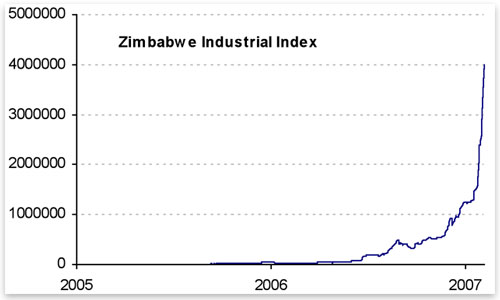
Zimbabwe??
del.icio.us | digg | technorati | stumble upon | furl | redditThe Catholic Church Can Save Zimbabwe
Filed under: Africa ~ Zimbabwe
The latest Publius feature article title, "The Catholic Church Can Save Zimbabwe," can be found by clicking on this link, looking at the right sidebar, or clicking on the Articles tab. It explores the relationship of the Catholic Church's support for the liberation of Poland and ties it into the potential for support that it can give to the people of Zimbabwe in their own struggle. Check it out.
del.icio.us | digg | technorati | stumble upon | furl | redditZimbabwe State Journalist Killed Over The Truth
Filed under: Africa ~ Zimbabwe
Disturbing images revealing Mugabe's henchmen brutally beating opposition leaders last month were leaked to the West, greatly amplifying the shock that many felt reading through the headlines. The name of this brave journalist is Edward Chikombo, a cameraman for state-run broadcaster ZBC. Or should I say, was? Revealing his name on this site makes no difference. Today, he turned up dead about 50 miles away from the capital.
del.icio.us | digg | technorati | stumble upon | furl | redditAfrican genocide marathon
Filed under: Africa
In preparation for my trip to Africa this summer, I've been immersing myself in all types of media including books and video. So I've been watching and in some cases re-watching movies like Hotel Rwanda, Lord of War, Blood Diamond, etc. The Travel Channel also has a lot of interesting documentaries that they play that talk about everything from culture to geography.
So here's my question and I hope a lot of you out there give me your input in the comments! What books, movies, documentaries, etc. would you recommend regarding Africa?
del.icio.us | digg | technorati | stumble upon | furl | redditZimbabwe's opposition leader arrested
Filed under: Africa ~ Zimbabwe
A thin red line exists between what we morally can and cannot do. Such a line exists for all people, except for Robert Mugabe. His line is the horizon -- no matter how much he pushes the boundaries, it moves further and further away. He has systematically turned Zimbabwe into hell on earth, but even most tyrants will allow their opposition to exist in name while restricting their activities. Not Mugabe. He thinks that he's God himself. So I guess it should be no surprise that he has taken his rule one step further by arresting opposition leader Morgan Tsvangarai.HARARE, Zimbabwe — Police stormed the main opposition party headquarters Wednesday and arrested its leader shortly before President Robert Mugabe left for an emergency meeting of southern African leaders about the crisis in Zimbabwe.Zimpundit says that this shows that Mugabe is willing to do anything to crush the opposition and remain in power. Certainly so. In the moment, one would find it impossible to believe that genocide in Rwanda and Sudan could actually happen until it is well underway, regardless of the plentiful signs pointing in that direction well ahead of time.Morgan Tsvangirai and other Mugabe opponents were taken into custody hours before the opposition leader planned to talk to reporters about a wave of political violence that left him briefly hospitalized.
Police sealed off approaches to the Movement for Democratic Change headquarters and fired tear gas to drive away onlookers before taking Tsvangirai and the others away in a bus, said Eliphas Mukonoweshuro, an aide to Tsvangirai.
"We don't know their whereabouts. We don't know if they have been charged," he said.
Meanwhile, the world stands by idly interpreting events and, rather than acting on that analysis, hopes that the horizon will eventually end. A cartoon posted by Sokwanele sums it up:

del.icio.us | digg | technorati | stumble upon | furl | redditThe state of the system
Filed under: Africa
Former vice-president of Zimbabwe, Joshua Nkomo, writes a very interesting article in the Zimbabwe Independent about what he sees as what needs to be done in order to ensure the freedom of its people. It was very interesting, and at least I got the point, but I couldn't help but be sidetracked from one paragraph of the column that makes an assertion about political systems that I feel compelled to further explore. Here's what he wrote:A one-party state, sincerely operated, may indeed be a way of encouraging an open and constructive debate. A multi-party state, badly operated, may be just another way of keeping an elite in power. The point is it is not the formal system that really matters, but the spirit in which a single or multi-party state is managed or operated. What matters is that the leadership should tolerate and encourage diverse opinions to be heard -- opinions of different social groups, differ-ent economic interests, different regions. Since geographical regions within Afri-can nations tend to be inhabited by people of different languages and cultural backgrounds, partly as a result of colonial boundaries, regional dynamics to national politics are vitally important: recognising and accommodating regional differences is the best way to prevent them turning into counter-productive tribal rivalries. Diversity must be appreciated, celebrated and tapped for collective national good.Being largely a proponent of structural factors, I wonder: Is this even possible in most cases? Won't most leaders, in single party states, simply opt for absolute power regardless of their previous noble ambitions? Are diverse opinions and rights something that can be guaranteed by a leader, or something that has to be built into the system in a way that they cannot be breached on a whim? Mugabe himself is a prime example of this. Therefore, I think that power cannot be trusted, and must be restrained by the system itself.
Let me know what you think, as I would like to discuss these ideas and turn them into a larger article to post soon.
del.icio.us | digg | technorati | stumble upon | furl | redditHistoric Mauritanian political debate airs across the globe
Filed under: Africa
The candidate debate leading up to the second round of Mauritania's presidential election is debuting momentarily on Al Jazeera tonight, to be broadcast across the entire region. Suehp Rom calls it "North Africa's equivalent of the Nixon-Kennedy debate." Hardly has ever a moment like this passed in the region, where two candidates are able to freely debate issues of importance to the country in order to legitimately win the votes of the people. From what I know, it will center on international political affairs, such as regional issues and relations with Israel, as well as local politics and rights.
Say what you want about Al Jazeera. It may have a lot of anti-American and and otherwise stupid commentary, but they have a lot of good and interesting content too. Remember, they aren't an American channel -- they're an Arab channel. And the fact that they are the ire of Arab governments everywhere shows how much they've been able to advance the debate on many key issues.
del.icio.us | digg | technorati | stumble upon | furl | redditSend in the ninjas
Filed under: Africa
Following a brutal crackdown on the opposition, Mugabe has become more isolated than ever. Even the African nations can no longer ignore the plight of Zimbabwe's people, as they have done for so long. Even Mugabe's own party and security services, discontent with their own standard of living and the constant danger they are in by enforcing such a regime, are turning on him. The entire country is about to collapse. What's a lone dictator to do?
Why, send in the ninjas, of course! I didn't know they had ninjas in Africa, but Angola apparently is flush with them. Must be all that recent Asian investment...Angola is sending 2500 of its feared paramilitary police to Zimbabwe, raising concerns of an escalation in violence against President Robert Mugabe's opponents, it was reported today.So this is what it comes down to. Most of Mugabe's security forces really are human. They have families to take care of, which is the only reason they would take such a job. But they also live amongst the very people that they repress. Living standards have also gone down so much that the consequences of their actions are no longer worth the pay. They've been abandoning their master -- along with teachers, civil servants, and other public employees -- because the benevolent dictator can't even feed them anymore!Zimbabwe's Home Affairs Minister Kembo Mohadi confirmed the imminent arrival of the Angolans, Britain's The Times reported today.
He said 1000 Angolans were expected on April 1, with the rest to follow in groups of 500.
The paramilitaries, notorious for their violence and dubbed ninjas for their all black uniforms, form part of the presidential guard of Jose Eduardo dos Santos, who has been in power in Angola since 1979.
[...]
This was the first time there has been such a large group, one source said.
With his forces abandoning him, he must look outside to foreign forces. These are people who don't live amongst the ZImbabweans and don't face the consequences of their actions. It's a typical move used by everyone from the Iranians to the Chinese to repress domestic discontent. But it has become obvious that Zimbabwe is reaching a tipping point. With the church calling for Mugabe to be toppled, and people so hungry that they don't care whether they live or die, mass action is going to happen. Soon.
del.icio.us | digg | technorati | stumble upon | furl | redditMore on Mauritania's move toward democracy
Filed under: Africa
If you were interested in the article on Mauritania's burgeoning democracy, then you're probably one of the few who would want to get into the nitty gritty of it. The Head Heeb is following the minute-by-minute politics and flip flops going on leading up to the presidential election runoff. I suggest his posts on it, because he seems to have a fondness for writing in-depth and analytically about these kinds of things that would drive anyone else bonkers...
del.icio.us | digg | technorati | stumble upon | furl | redditWarning: include(/home/users/web/b2739/ipw.publiusp/public_html/left_sidebar.php): failed to open stream: No such file or directory in /hermes/bosnacweb07/bosnacweb07ar/b2739/ipw.publiusp/public_html/africa/index.php on line 626
Warning: include(): Failed opening '/home/users/web/b2739/ipw.publiusp/public_html/left_sidebar.php' for inclusion (include_path='.:/usr/local/lib/php-7.3.2-xenial/lib/php') in /hermes/bosnacweb07/bosnacweb07ar/b2739/ipw.publiusp/public_html/africa/index.php on line 626
Warning: include(/home/users/web/b2739/ipw.publiusp/public_html/right_sidebar.php): failed to open stream: No such file or directory in /hermes/bosnacweb07/bosnacweb07ar/b2739/ipw.publiusp/public_html/africa/index.php on line 630
Warning: include(): Failed opening '/home/users/web/b2739/ipw.publiusp/public_html/right_sidebar.php' for inclusion (include_path='.:/usr/local/lib/php-7.3.2-xenial/lib/php') in /hermes/bosnacweb07/bosnacweb07ar/b2739/ipw.publiusp/public_html/africa/index.php on line 630